
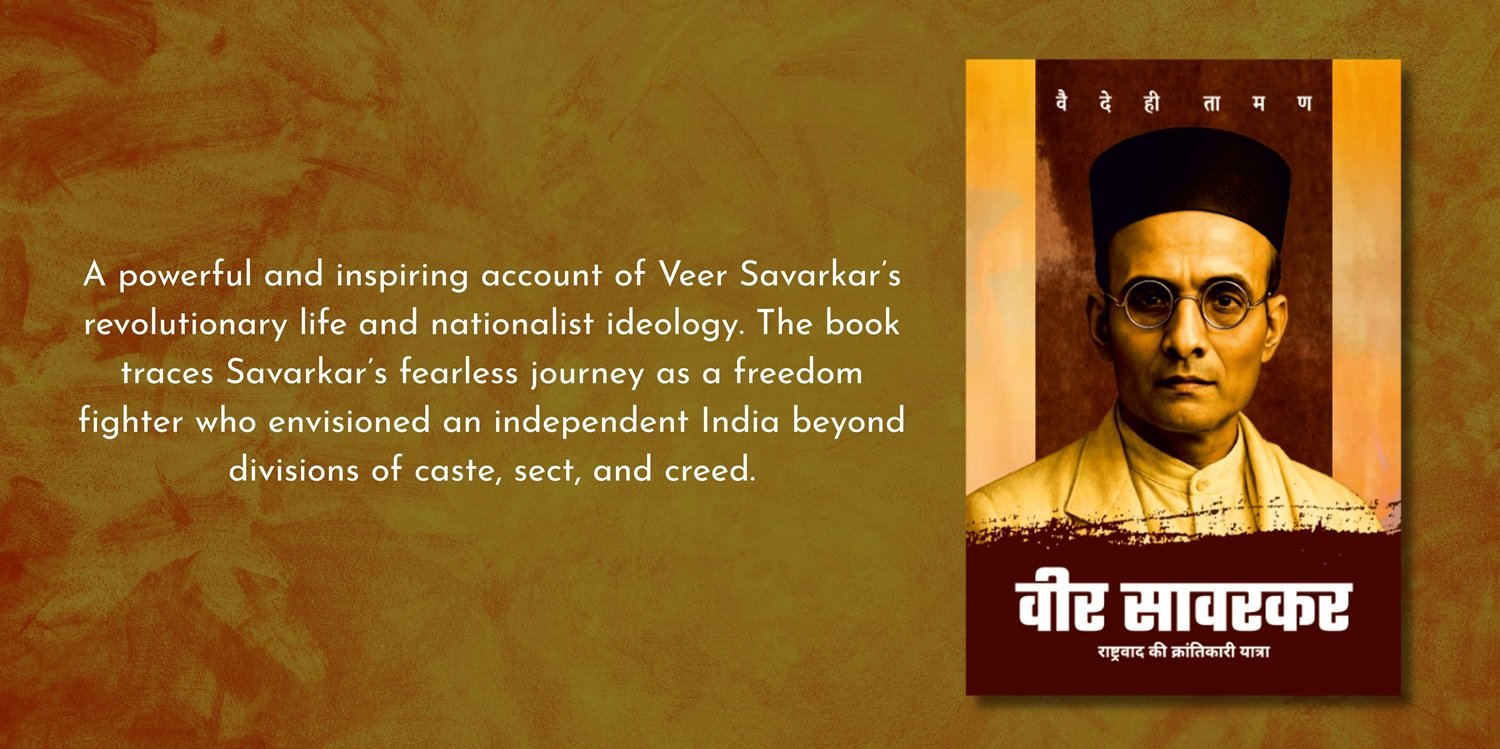
Veer Savarkar: Rashtravaad Ki Krantikari Yatra is not just a historical account but a deeply ideological and thought-provoking exploration of nationalism through the life and ideas of Vinayak Damodar Savarkar. In this book, Dr. Vaidehi Taman attempts to reintroduce Savarkar not merely as a freedom fighter, but as a visionary thinker whose ideas, she argues, remain highly relevant in contemporary India.
The book’s central argument is clear: political independence was only the first step in India’s journey, while the true struggle lies in reclaiming its cultural and civilizational identity. Through accessible and engaging language, the author takes readers through Savarkar’s concept of nationalism, particularly his interpretation of Hindutva as a cultural and civilizational identity rather than a narrowly defined religious doctrine.
One of the book’s strengths is its effort to simplify complex ideological ideas for younger readers. Taman presents Savarkar’s thoughts on social reform, national unity, military strength, and resistance to caste discrimination in a structured and digestible manner. This makes the book especially appealing to those who are new to political or historical discourse but are curious about India’s intellectual foundations.
The narrative also highlights how, according to the author, historical distortions and ideological biases have shaped public perception. Taman takes a firm stance, critiquing left-leaning narratives and positioning Savarkar’s ideology as a corrective force capable of restoring cultural pride and unity. This perspective gives the book a strong voice, though it also means that the work leans more toward advocacy than neutral analysis.
Stylistically, the writing is straightforward and purposeful. It avoids academic complexity and instead focuses on clarity and impact. While this makes the book highly readable, some readers may wish for a more balanced examination of differing viewpoints on Savarkar’s legacy, which remains a subject of significant debate in modern India.
What ultimately stands out is the book’s sense of urgency. It does not treat Savarkar as a figure of the past, but as a guide for the present and future. The message is clear: the revival of cultural consciousness and national identity is an ongoing task, and Savarkar’s ideas are presented as a roadmap for that journey.
In conclusion, Veer Savarkar: Rashtravaad Ki Krantikari Yatra is a compelling and accessible introduction to Savarkar’s philosophy, particularly for readers interested in nationalism, cultural identity, and modern Indian thought. While it reflects a strong ideological stance, it succeeds in sparking reflection and discussion, which is perhaps its greatest achievement.